When to Remove a Pine Tree in Raleigh, NC
When to Remove a Pine Tree in Raleigh, NC Most homeowners notice something is wrong with a pine tree long before they know what to do about it. The tree sways harder than the others in a storm. The needles are turning brown in patches. There’s a lean that wasn’t there last year. The question is not just whether something looks off; it’s whether what you’re seeing is actually serious. “A pine tree needs to be removed if it shows large structural cracks, soft fungal conks at the base, more than 50% dead canopy, or a sudden lean indicating root failure — defects that compromise structural integrity in ways that cannot be reversed by pruning or treatment.” In a region…
When to Remove a Pine Tree in Raleigh, NC
Most homeowners notice something is wrong with a pine tree long before they know what to do about it. The tree sways harder than the others in a storm. The needles are turning brown in patches. There’s a lean that wasn’t there last year. The question is not just whether something looks off; it’s whether what you’re seeing is actually serious.
“A pine tree needs to be removed if it shows large structural cracks, soft fungal conks at the base, more than 50% dead canopy, or a sudden lean indicating root failure — defects that compromise structural integrity in ways that cannot be reversed by pruning or treatment.”
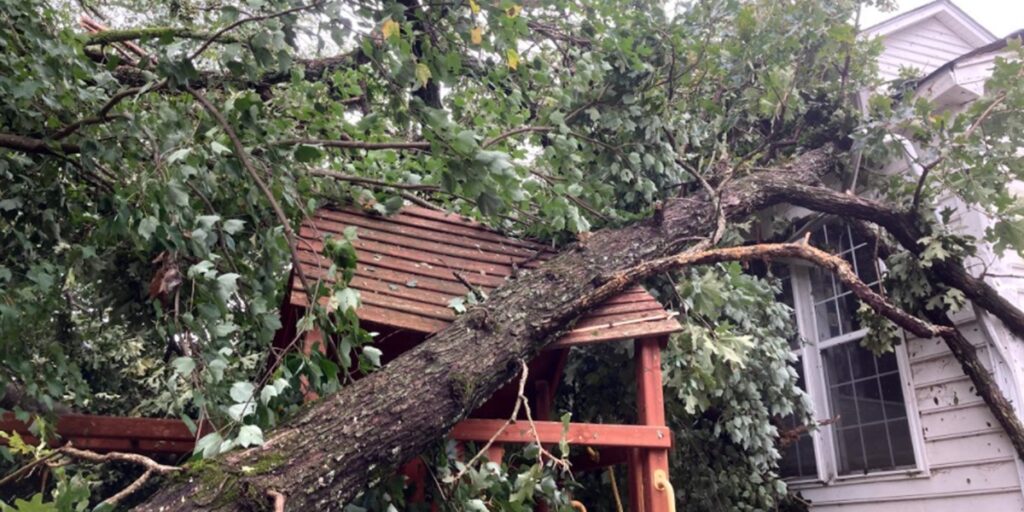
In a region like Raleigh, NC, where Loblolly pines routinely reach 85 to 115 feet, a failing tree isn’t just a landscape problem. It’s a safety emergency. This guide covers what to look for, what it means, and when to act.
Why Pine Trees Demand More Attention Than Other Trees: When to Remove a Pine Tree in Raleigh, NC
Pine trees behave differently than hardwoods, and that difference matters when you’re trying to evaluate risk.
In wind events, pine trees sway two to three times more than oaks, maples, or poplars. The combination of needle foliage and a more flexible wood structure means a pine absorbs and responds to wind load in a way that makes it visually alarming (and sometimes genuinely dangerous) while the hardwoods nearby barely move.
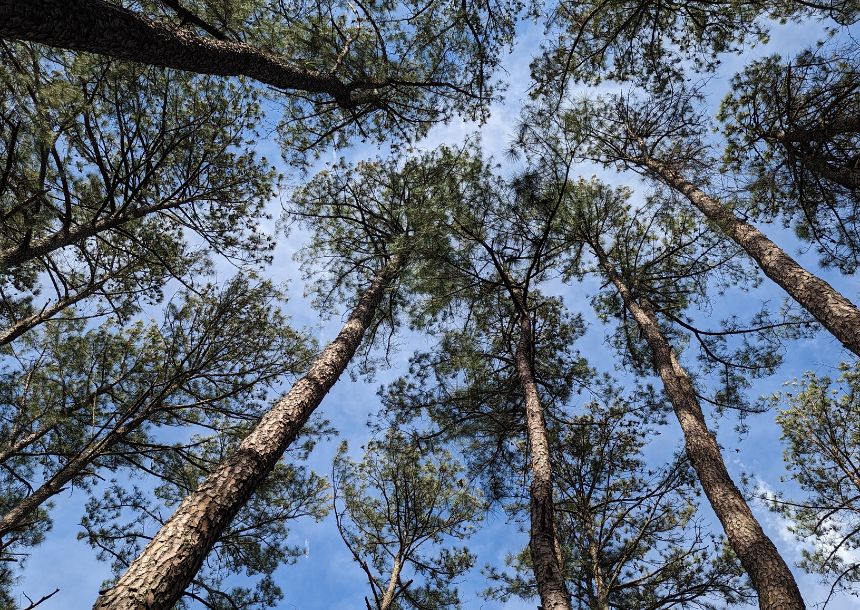
Height makes this worse. In greater Raleigh, Wake County, and Durham County, Loblolly and Yellow pines commonly reach 85 to 115 feet. Because pines grow faster than hardwoods, they outcompete neighboring trees for light by growing taller.
In established neighborhoods, pines on the edge of the wood line often grow outward and into the yard rather than straight up. This is why so many pine trees in areas like the Six Forks Road corridor, the Creedmoor Road corridor near Falls Lake, Hayes Barton, and Cowper Drive have a noticeable lean toward a structure.
Ice storms compound the risk even further. Hardwoods drop their leaves in winter, which means ice accumulates on bare branches. Pine trees keep their needles year-round, which means they collect significantly more ice load during a winter event, and fail at much higher rates as a result.
That’s the baseline risk profile. Everything below describes the specific signs that a particular tree has crossed from manageable risk into urgent problem.
When to Remove a Pine Tree in Raleigh, NC: Signs You Can’t Wait On
The following symptoms indicate structural failure that is either already in progress or imminent. If you observe any of these, contact a certified arborist before the next wind or rain event.
Sudden Leaning
A healthy pine grows straight. If a tree that was previously upright develops a visible tilt – especially after a storm – the root plate may be failing. Go to the base of the tree and look at the ground on the opposite side of the lean. Cracked or raised soil, exposed lifting roots, or ground that feels soft and spongy underfoot are all signs that the root system has partially separated from the soil.
This is what soil heaving looks like: a crack in the ground wide enough to put your hand into, inconsistent firmness when you step around the base, or a general sense that the ground near the roots is no longer stable.
A lean that develops suddenly is a different animal from a tree that has grown at an angle for years. Many pines in Raleigh that were partially uprooted during Hurricane Fran in 1996, or the ice storm of 2002, have since stabilized and grown into their lean. Those trees are not automatically a removal candidate. A fresh lean, especially one that appeared after a recent storm or wet soil event.
Large Structural Cracks or Splits
Long vertical cracks or deep splits running down the main trunk indicate that the wood’s internal structure has been compromised. These are not surface wounds. They represent actual separation in the wood fiber that weakens the tree’s load-bearing capacity. A tree with severe trunk damage of this kind is at risk of snapping, rather than toppling, which makes the failure pattern less predictable and more dangerous.
Fungal Growth at the Base
Mushrooms, bracket fungi, or conks growing directly from the lower trunk or major root flares are not incidental. Soft fungal conks at the base of a pine tree signal severe internal root rot or trunk decay. The fungal fruiting bodies are visible evidence of a decomposition process that is already well advanced inside the wood. By the time you can see the conks, the structural damage is typically extensive.
Missing or Peeling Bark
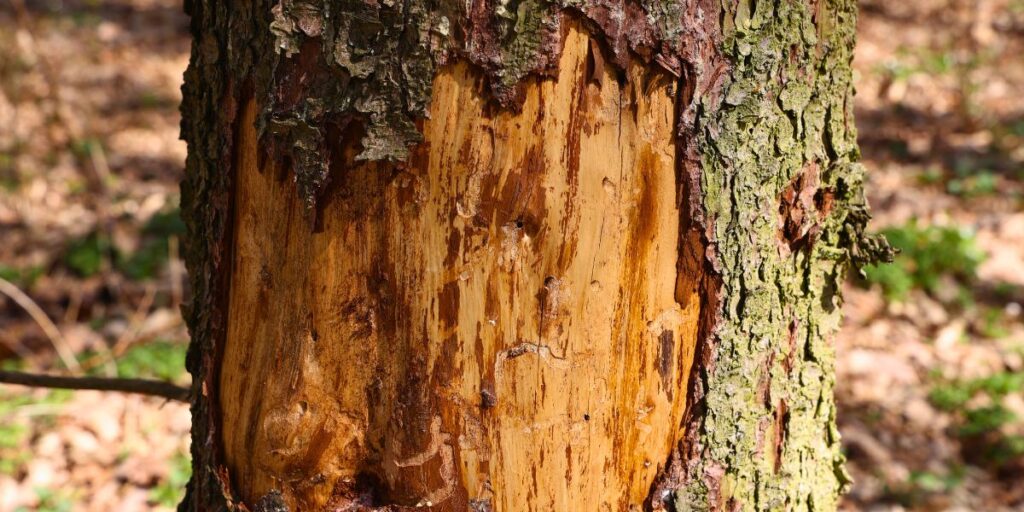
Patches of bark dropping off to reveal dry, dead inner wood mean that section of the tree is dead and highly brittle. This is particularly dangerous in a tall pine because brittle wood, high in the canopy, can fail and drop without warning.
Canopy and Needle Warning Signs: What’s Serious and What Isn’t
Brown needles are the most common reason homeowners call about a pine tree, and they’re also one of the most misread signs. Not all browning means the tree is dying.
Pine trees shed older interior needles every year as part of a normal process called needle cast. If the browning is concentrated on interior needles closer to the trunk while the branch tips remain green, this is seasonal shedding. It looks alarming in late summer and fall, but is not a sign of disease or decline.
What you’re actually watching for is different: needles turning greyish-green and then brown from the outside in, tip dieback progressing from the outer branches inward, or a browning pattern spreading visibly from one section of the canopy to another. These patterns suggest Pine Wilt, needle blight, or other lethal conditions rather than normal shedding.
The 50% Rule
If more than 50% of the pine’s needles are brown, brittle, or have fallen off, the tree is typically in terminal decline. This threshold exists because a pine tree cannot recover photosynthetic capacity once canopy loss reaches this level.
Top-Down Dieback
If the crown (the very top of the tree) turns entirely brown or is lost in a storm, the tree loses its primary growth point and will rot downward from the top. This is a removal situation, regardless of what the lower canopy looks like.
The Scratch Test
If you’re unsure whether a branch is dead, use a fingernail or a knife to gently scrape away a small piece of bark on a few twigs. Green and moist underneath means the branch is alive. Brown, dry, and brittle underneath means that section is dead. You can use this to map how far dieback has progressed before calling for a professional assessment.
Pine Bark Beetles and Disease: What You’re Actually Looking For
Bark beetle damage is one of the faster-moving threats to pine health and is often missed until it’s too late because the visible signs are small.
Look for tiny exit holes (roughly the size of a pencil lead) scattered across the bark surface. At the base of the tree or within bark crevices, you may find sawdust-like frass, the material beetles leave behind as they bore through the wood. On the outer bark, pitch tubes (small, gooey clumps of hardened sap) are the tree’s attempt to push the beetles out and are a reliable confirmation of active infestation.
An extensive bark beetle infestation is typically fatal. The beetles disrupt the tree’s ability to move water and nutrients from the roots to the canopy, and once the infestation is advanced, treatment is rarely effective.
A rapid color transition, such as the entire tree shifting from an unnatural greyish-green to yellow-brown over the course of a few weeks, can indicate pinewood nematodes, microscopic worms spread by Pine Sawyer beetles that cause a condition sometimes called Pine Wilt. This type of decline moves fast and cannot be reversed once it has progressed significantly.
When Trimming Won’t Fix the Problem
Tree trimming serves a specific purpose: removing limbs that are encroaching on a roof, increasing light into the yard, or improving how the house looks from the street. It is a maintenance tool, not a structural one.
If a pine tree has a compromised root system, advanced internal decay, or a canopy that has declined past the point of recovery, trimming cannot address those problems. Pruning removes wood from a tree that is already struggling to maintain structural integrity. In some cases, heavy pruning on a structurally compromised pine accelerates decline rather than slowing it.
The practical distinction is this: trimming addresses what the tree looks like and how it interacts with its surroundings. Removal addresses whether the tree is safe to leave standing. These are different evaluations, and confusing them leads homeowners to spend money on pruning a tree that should have come down.
Pine Tree Removal in Raleigh: When to Call a Professional
If your pine tree is showing any of the critical signs covered above (sudden lean with soil heaving, fungal conks at the base, more than 50% canopy loss, or bark beetle evidence), the next step is a professional assessment, not a wait-and-see approach. Tall pines in residential areas have very little margin for delay once structural failure has begun.
“Pine tree removal in Raleigh requires a professional arborist who can assess internal decay and other tree health factors that are not obvious at first glance, evaluate whether the root plate has been compromised, and determine whether the tree can be stabilized or needs to come down.”
This kind of evaluation is especially important given the prevalence of large Loblolly pines in established neighborhoods throughout North Raleigh, inside the beltline, and across Wake and Durham Counties.
For pine trees that do need to come down, early removal (before a storm event forces the issue) is almost always safer and less expensive than emergency removal after a failure. It also protects the surrounding landscape. That is a cost factor that doesn’t appear in the removal quote, but absolutely appears in the restoration bill afterward.