What To Expect During Crane-Assisted Tree Removal
Residential crane-assisted tree removal is a specialized, fast, and safe method for removing large, hazardous, or hard-to-reach trees in tight residential spaces, and it is often completed in a single day. When most homeowners picture tree removal, they assume it’s a simple matter of cutting the tree and hauling it away. In reality, crane-assisted removals are some of the most carefully planned projects we perform. What you’ll actually see on removal day is a highly choreographed operation where tree sections are lifted over homes, floated across rooflines, and set down in a designated processing zone, all without a single piece touching your house or landscape. Using a crane allows us to remove trees safely in tight spaces, protect surrounding structures,…
Residential crane-assisted tree removal is a specialized, fast, and safe method for removing large, hazardous, or hard-to-reach trees in tight residential spaces, and it is often completed in a single day.
When most homeowners picture tree removal, they assume it’s a simple matter of cutting the tree and hauling it away. In reality, crane-assisted removals are some of the most carefully planned projects we perform.
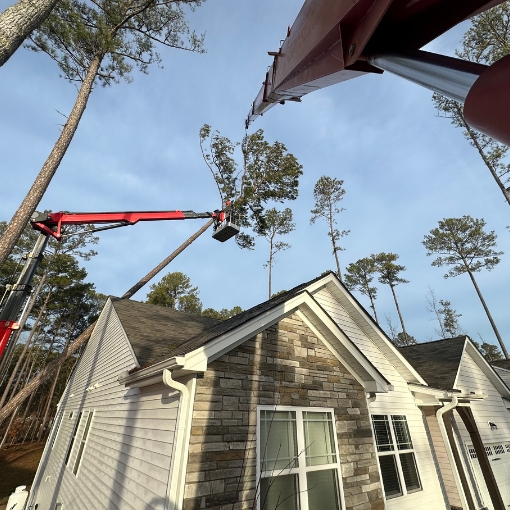
What you’ll actually see on removal day is a highly choreographed operation where tree sections are lifted over homes, floated across rooflines, and set down in a designated processing zone, all without a single piece touching your house or landscape.
Using a crane allows us to remove trees safely in tight spaces, protect surrounding structures, and complete complex jobs far more efficiently than traditional methods.
Because crane work is not something most homeowners see every day, we want to walk you through exactly what to expect, from the moment we assess your property to the final cleanup of the landing zone. We’re a full-service tree service in Raleigh, and crane work is some of the most complex we do.
Understanding Crane Tree Removal Cost
Residential crane-assisted tree removal cost depends on crane size required, project duration, and debris hauling volume. Not just the size of the tree.
One of the most common mistakes homeowners make is focusing on the high upfront quote for crane work without comparing it to the full potential cost of traditional removal, which includes manual rigging labor, longer crew hours, and the very real possibility of repairing landscape or structural damage when something goes wrong.
The crane often saves money. The work is significantly faster, requires less manual rigging, and dramatically reduces the risk of a limb contacting your home, fence, or HVAC equipment. In tight-access or high-risk scenarios, crane-assisted removal is frequently the most economical choice, not the most expensive.
What Actually Drives the Price of Crane-Assisted Tree Removal
Crane size required for the job, project duration, and debris hauling volume are the three primary variables in your quote. A single medium-sized tree with easy access looks very different on paper from a large declining oak overhanging a garage on a narrow urban lot.
| Scenario | Equipment | Complexity Factors | Est. Range |
|---|---|---|---|
| Single medium-sized tree, easy access | Compact crane, 1 operator + 2 crew | Standard driveway landing zone; 1 day | $1,500–$2,500 |
| Large tree overhanging roof or garage | Mid-size crane, full crew, protective matting | Tight drop zone; possible 2-day setup | $2,500–$4,500 |
| Multiple trees or severe decay | Large crane + bucket truck combo | Extended hauling; multiple log loads | $4,500–$7,000+ |
NOTE: These ranges are example estimates. Your specific site conditions, tree condition, and required equipment may vary, and that will affect your quote.
Why Crane-Assisted Tree Removal Is Often the Safest Method
Crane-assisted tree removal drastically reduces the risk of property damage by replacing gravity-dependent rigging with controlled vertical lifts, eliminating the most common failure points in traditional removal.
Safety is always the first thing we consider. When we look at a tree, especially one that’s dead, declining, or overhanging structures, the question becomes: which method allows us to remove it with the least risk and the greatest control? A crane often becomes the safest tool for hazardous tree removal.
Dead or Decaying Trees Can Be Unsafe to Climb
A tree doesn’t fall apart the day it dies, but it does begin to decline quickly. Depending on what caused the death, a tree can become unsafe to climb within 60 to 90 days of losing its leaves or needles. Once the wood begins to soften or separate internally, a climber’s rope or weight can cause limbs to shear unexpectedly.
When we encounter this kind of compromised structure, a crane allows us to rig a crane sling around each section and lift it without relying on the tree itself to hold a climber. This eliminates a major point of risk.
Cranes Prevent Damage to Nearby Structures
Many of the trees we remove overhang homes, garages, fences, pools, or neighboring properties. If we tried to climb those trees and lower pieces down by rope, the material would naturally swing or drop in the direction of the house. That means slow cuts, tiny segments, and a lot of opportunity for something to touch a structure you care about.
With a crane, we can “float” each section up and over the home and set it down in a safe landing zone. It’s controlled, predictable, and far more efficient.
Crane Work Reduces the Impact on Your Property
One major misconception is that crane removals are more damaging to a yard. Often, it’s the opposite.
When we remove a tree by climbing, the debris must come down directly beneath the canopy, with a lot of material hitting the ground in a concentrated area. With a crane, large sections are lifted completely over the landscape and gently laid down in a designated drop zone, often the driveway or the street, so nothing impacts your lawn, flowerbeds, or hardscape.
A Real Example From the Field
Recently, we removed a large willow oak that was declining and dropping limbs. The tree overhung two garages and the client’s home on a very small inside-the-beltline lot. The trunk stood just four feet from one garage.
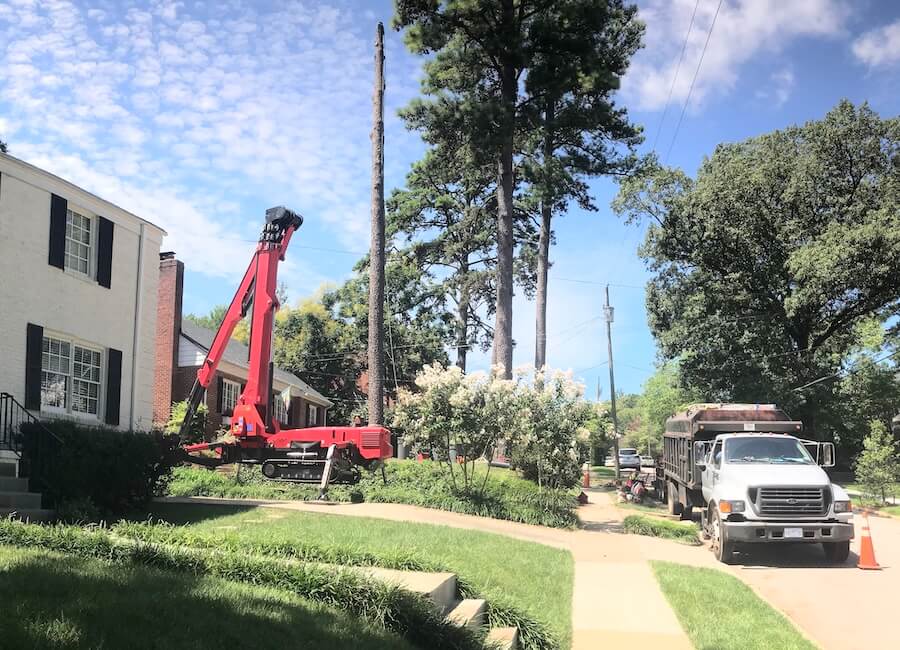
The only safe way to remove it was with our compact crane, which we maneuvered down the narrow driveway. By taking small pieces one at a time and establishing a clear drop zone in the street, we were able to remove the tree without impacting either structure, something that simply couldn’t have been done safely without the crane.
Your Site Preparation Checklist Before the Crane Arrives
Homeowners must prepare their property for safe machinery access. The tree’s proximity to your house and available driveway access are the two factors that most directly determine how the crane is positioned and how the job unfolds.
Before the heavy machinery arrives, a few simple steps on your end help the crew move faster and keep your property protected:
- Clear your driveway. Move all personal vehicles out of the driveway and away from the street front. The crane, and often a chip truck and log truck, needs clear access to position safely.
- Coordinate with neighbors. Let adjacent households know. On tighter lots, the crane may need to swing sections over property lines, and it’s better to give neighbors a heads-up than a surprise.
- Clear the yard. Relocate outdoor furniture, grills, lawn ornaments, toys, and potted plants from the work zone. The crew will be moving quickly and a clear site helps.
- Unlock access gates. Ensure the tree crew has unobstructed pedestrian paths to the tree site.
- Secure your pets. Keep all animals inside throughout the active work period. Equipment noise is significant and unpredictable movement near animals is a safety concern.
- Mark hidden obstacles. Point out buried property assets like underground septic lines or sprinkler heads so the crew can position the crane and outriggers safely.
During your initial assessment, we also look at several factors on our end:
- Tree health. Is it sound enough to climb or rig traditionally, or is decay present?
- Tree position. Does it overhang a structure or tight space?
- Access. Can we reach the tree safely with the crane, bucket truck, or aerial lift?
- Landing zone availability. Is there space to lay down each section of the tree?
- Impact tolerance. How much disruption to your lawn or driveway is acceptable?
We choose crane-assisted removal when it is safer, more efficient, or less damaging than the alternatives. We own multiple cranes, large, compact, and mid-sized, so we can match the equipment to the property instead of forcing a one-size-fits-all approach.
The Choreographed Process of Crane-Assisted Lifting Over Homes
Certified, experienced operators work to lift, swing, and lower heavy tree sections, preventing accidents and minimizing risk to nearby structures through a highly controlled, step-by-step sequence.
What you’ll see on removal day is not a chaotic work site. It’s a carefully sequenced operation, with each stage building on the last.
1. Equipment Positioning and Protective Matting
Before we begin, we discuss where equipment will be placed and what areas matter most to you. Protecting your property is a priority, and sometimes that means deploying outriggers and laying down thick protective matting, such as plastic, plywood, or in extreme cases, 10 inches of timber, to distribute the weight of the crane without leaving lasting impressions on your lawn.
We use as much matting as needed. Some days, that’s a few sheets; other times, it’s nearly a tractor-trailer load.
2. Crane Setup and Leveling
Cranes must be perfectly level before they can be deployed. The operator positions the crane on a hard, stable surface, usually your driveway or the street, then extends the outrigger arms and places outrigger pads on the ground to safely distribute the load. Cribbing and adjustment blocks are often required. This preparation work is crucial for safety and takes as long as it needs to.
3. Rigging and Controlled Lifting of Tree Sections
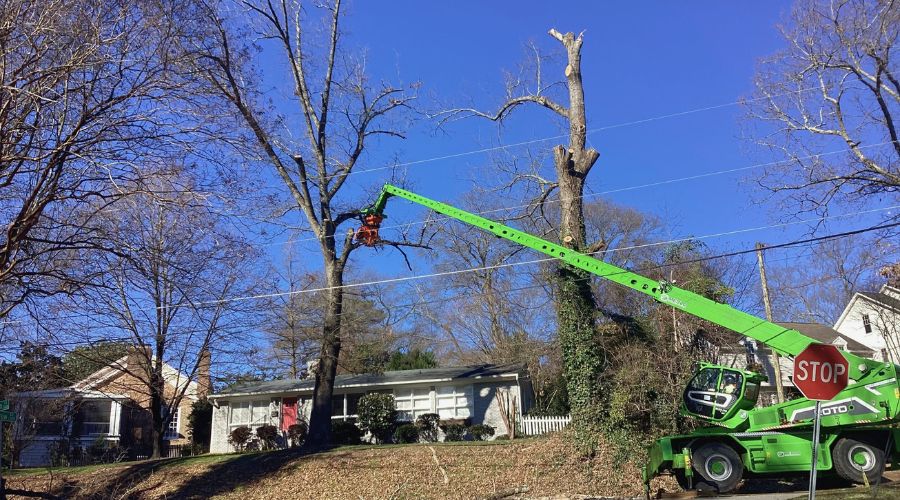
The crane operator and climber, or bucket operator, work together to remove the tree in manageable pieces. The climber secures a crane sling or heavy-duty cable around a specific section, then applies tension to the load before making the cut. That sequence matters: applying tension first ensures the crane is fully supporting the weight before the chainsaw makes contact, so the piece lifts cleanly rather than dropping or swinging.
Once secured, the arborist makes a precision cut. The severed piece is lifted straight up, carried in a controlled flight path over your property, and set down in the designated drop zone, usually the driveway or street.
If the tree is unusually decayed, the picks may be smaller; if it is sound but large, the picks may be heavier. Everything depends on the crane chart, tree condition, and landing zone constraints.
4. Processing in the Landing Zone
Once a section is placed in the drop zone, the ground crew processes it:
- Removing limbs
- Running brush through the wood chipper
- Cutting logs into pulpwood, saw logs, or firewood for recycling
We recycle 100% of the wood we remove.
5. Repeating Picks Until the Trunk Is Gone
Some trees come out in just a few lifts; others require dozens. But the goal is always the same: remove all material safely without affecting your home or landscape.
6. Final Cleanup
We blow debris from hard surfaces, pick up small wood scraps, and leave the site looking clean and orderly.
What to Expect on Tree Removal Day
Trade-offs to accept include substantial noise, minor ground impressions from machinery, and potentially blocked street access, all temporary and fully anticipated by your crew.
- Substantial noise. Expect high-decibel disruption from crane engines, heavy diesel trucks, and commercial chainsaws throughout the workday.
- Minor ground impressions. Even with protective mats, crane tires and outrigger pads can cause minor turf compaction or grass scuffing on soft ground.
- Tight workspaces. In dense urban neighborhoods, setup can feel incredibly tight and may block local street access temporarily.
These disruptions are temporary and fully anticipated by your crew. We work to minimize them at every stage. Learn more about how crane tree removal works.
Crane Tree Removal vs. Bucket Truck Removal: Which Do You Need?
A professional operator and bucket truck gives our experts reach without climbing, but the main difference between crane tree removal and bucket truck removal comes down to one question: does the tree need to be lifted vertically over a structure, or simply accessed from above?
Homeowners often ask whether we can use a bucket truck instead of a crane. Both have advantages, but they’re designed for different situations.
When a Bucket Truck Is the Better Choice
- When the tree is sound enough to be accessed traditionally
- When limbs simply need to be pruned back from the roof, siding, or service wires
- When there is adequate truck access and stable ground
- When the job doesn’t require lifting large pieces over structures
Bucket trucks also allow us to reach areas climbers can’t safely stand on, like long limbs over swimming pools that would bow under a person’s weight.
When a Crane Is Necessary
- When the tree is dead or structurally compromised
- When branches, or the trunk, overhang homes, garages, pools, or power lines
- When dropping limbs would damage the property
- When tight spaces make traditional rigging unsafe or impossible
The difference between crane removal and bucket truck removal isn’t just equipment, it’s the method of getting material out of the tree. A bucket truck positions a worker; a crane moves the wood.
Sometimes, We Use Both Methods
One recent example involved a large American Beech with extensive decay. Half the tree extended over high-voltage power lines; the other half stretched over the client’s home. The crane needed to be positioned under part of the canopy, which meant we first used the bucket truck to remove enough limbs to create space for a safe crane setup. Only then could the crane finish the job.
This kind of layered strategy is common on complex sites.
Tree removal is a form of controlled demolition. What you’re really buying isn’t the tree being cut up, it’s the expertise, equipment, and planning required to avoid damage and complete the project safely.
Crane-assisted tree removal gives us the ability to perform work that would otherwise be impossible, unsafe, or far more disruptive to your property. From deploying outriggers and laying protective matting, to rigging each section and coordinating the drop zone, every decision is made with your home and your safety in mind.
If you have a tree that’s overhanging your home, declining in health, or located somewhere that makes traditional removal risky, we’d be glad to walk your property and tell you exactly what we’d recommend. Contact us for professional tree removal in Raleigh.